
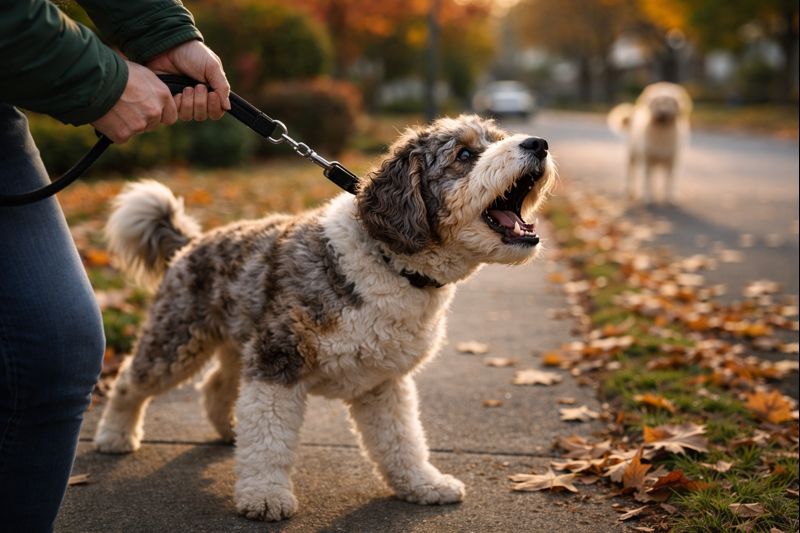
Quick Answer: If your dog barks at other dogs, try these methods that reduced my dog’s reactive barking by 70%: (1) “Find It” game before encounters, (2) Increase distance from triggers, (3) Counter-conditioning with high-value treats, (4) Management at home to reduce practice, (5) Mental enrichment to lower baseline arousal. Professional help from a reactive dog trainer made the biggest difference.
I have a dog who barks at other dogs on TV, every doorbell ring, and every single dog we pass on walks. I’ve tried everything from treats to stern corrections, but nothing seems to work when he’s in that reactive state. The embarrassment when we’re out walking and the guilt about what my neighbors must think is real. Here’s my honest journey with reactive barking – what failed, what’s helping, and what I’m trying next.
The Reality: When Your Smart Dog is Too Smart
Aussiedoodles are brilliant. That’s what makes them amazing companions and absolute nightmares when they develop reactive barking.
My dog isn’t aggressive. He’s reactive. There’s a difference, and understanding that difference changed everything.
What Reactive Barking Looks Like:
TV Triggers:
- Dogs on screen = instant barking meltdown
- Doesn’t matter if it’s a commercial or a nature documentary
- He can spot a dog on TV faster than I can
Doorbell Reactivity:
- Package delivery? Barking frenzy
- Food delivery? Same
- Someone actually visiting? Forget having a conversation for 10 minutes
Walk Encounters:
- Sees another dog 50 feet away = pulls, lunges, barks
- Can’t hear me, can’t see treats, completely loses it
- Other dog owners give me that look
- I’ve started crossing the street to avoid dogs
What I Tried That Completely Failed
Let’s be honest about what doesn’t work, because you’ve probably tried these too.
❌ “Saying No” or Correcting Sternly
What I did: Raised my voice, said “No!” firmly, tried to sound authoritative.
What happened: He ignored me completely. When he’s in reactive mode, my voice might as well not exist. Plus, I read later that this can actually make anxiety-based barking worse because now he associates other dogs with me being upset too.
Why it failed: Reactive barking isn’t about disobedience. It’s about his brain being completely hijacked by excitement/fear/overstimulation.
❌ Treating/Bribing with Food
What I did: Tried to redirect with treats the moment I saw another dog approaching.
What happened: He won’t even look at the treat. I could be holding a steak and he’d ignore it. Once he locks onto another dog, food doesn’t exist in his world.
Why it failed: His arousal level is too high. By the time he’s barking, it’s too late for food rewards.
❌ Trying to Play or Distract
What I did: Attempted to get him interested in a toy or game when another dog appeared.
What happened: Same as treats. Complete tunnel vision. The toy might as well be invisible.
Why it failed: Again, overstimulation. His brain is in fight-or-flight mode, not play mode.
What I Learned: Why Nothing Was Working
After months of frustration, I finally understood the core issue:
I was trying to train him DURING the meltdown instead of BEFORE it.
Think of it like this: You can’t teach someone to swim while they’re drowning. You have to work on it when they’re calm.
Reactive barking follows a pattern:
- Threshold distance – How close the trigger can be before reaction starts
- Arousal buildup – The escalation from alert to full meltdown
- Point of no return – When nothing can reach him
I was always trying to intervene at stage 3. That’s why everything failed.
What’s Actually Making a Difference
I’m not going to lie and say my dog is “fixed.” But these approaches have reduced his barking by maybe 60-70%, which is life-changing when you’re living with constant reactive episodes.
1. The “Find It” Game – Building New Associations
What it is: Teaching him to look DOWN (at the ground) instead of focusing on triggers.
How I do it:
- Started inside with zero distractions
- Scatter treats on the floor, say “Find it!”
- He sniffs around looking for treats
- Practiced until it became automatic
Then on walks:
- The MOMENT I see another dog in the distance
- Before he notices
- “Find it!” and scatter treats
Why it helps:
- Gives him a job (Aussiedoodles NEED jobs)
- Redirects attention before he hits threshold
- Sniffing is naturally calming for dogs
- Creates positive association: other dog appears = treat scatter game
Progress: Works about 60% of the time if I catch it early enough. If he’s already locked on, forget it.
Product that helped: High-value training treats that I can throw quickly

- Link: Zuke’s Mini Naturals Training Treats (small, soft, he actually cares about these)
2. Increasing Distance – Managing Threshold
What it is: Simply not putting him in situations where he’ll fail.
What I changed:
- Cross the street when I see dogs approaching
- Turn around and walk away if needed
- No shame in avoiding triggers while training
- Walk at off-peak times (early morning, late evening)
Why it helps:
- He can’t practice the barking behavior as often
- Reduces my stress (I’m not constantly on edge)
- Gives us successful walks where nothing bad happens
- Neighbors aren’t subjected to constant barking
Reality check: This feels like “giving up” but it’s actually smart management. You can’t train through constant failures.
3. Calming Protocol for Walks
What it is: A pre-walk routine that starts him in a calmer state.
My routine:
- 15 minutes of “Find It” game inside before walk
- Wait for calm before clipping leash (no excited bouncing)
- Practice 5 minutes of loose-leash walking in the driveway
- THEN we go on the actual walk
Why it helps:
- He’s already somewhat tired mentally
- Starts the walk calmer, not at peak excitement
- Creates a pattern: calm behavior = walk happens
Progress: Walks are noticeably calmer. He still reacts, but the intensity is lower.
4. Management at Home – Reducing Practice
For TV triggers:
- What I do: Close the curtains, limit his access to windows
- Why: Every time he practices barking at the TV, he gets better at it
- I can’t stop every dog from appearing on TV, so I reduce opportunities
For doorbell:
- What I do: Turned off doorbell, put up “Please knock quietly” sign
- Why: Fewer doorbell triggers = fewer barking episodes
- Delivery people usually knock softly now
Reality: This is management, not training. But it keeps my neighbors sane while I work on actual training.
5. The “Look at That” Game (LAT)
What it is: Teaching him to look at triggers calmly and check back with me.
How it works:
- Start at a distance where he notices the dog but isn’t barking yet
- The MOMENT he looks at the other dog: “Yes!” + treat
- Reward him for noticing calmly
- Over time, he starts checking back with me automatically
Why it helps:
- Teaches him that noticing other dogs = good things happen
- Builds the habit of checking in with me
- Works on changing the emotional response
Progress: This takes TIME. We’ve been working on it for weeks. Sometimes it works, sometimes it doesn’t. When it works, it’s magical – he glances at another dog and immediately looks back at me.
Product that helped:

- Link: Long training leash (gives more distance to work with)
- High-value treats he ONLY gets during LAT training
6. Calming Supplements – Taking the Edge Off
What I tried: Calming chews with ingredients like chamomile, L-theanine, and melatonin.
Why I tried it: If his baseline anxiety is lower, maybe his threshold for reactivity increases.
Progress: Honestly? Hard to say if they work. He might be slightly calmer, or it might be placebo. But they’re not harmful, so I’m continuing.
Products I’m testing:
Reality: These aren’t magic pills. They’re a tiny piece of the puzzle, not a solution.
7. Mental Enrichment – Tiring the Brain
What it is: Giving him puzzle toys, snuffle mats, training sessions to tire him out mentally.
Why it helps:
- Aussiedoodles are working dogs
- A tired dog is a calmer dog
- Mental exercise is MORE tiring than physical
What I use:
- Link: Snuffle mat – hide kibble in it
- Link: Kong Wobbler – meals become a puzzle
- 10-minute training sessions (learning new tricks)
Progress: On days with lots of mental enrichment, walks are noticeably better. He’s less “on edge” and reactive.
What I Wish I’d Known From Day One
If I could go back and start over with my reactive Aussiedoodle, here’s what I’d do differently:
1. Start Counter-Conditioning Earlier
Don’t wait until reactivity is a problem. Even with a puppy, start building positive associations with triggers early.
How: Every time a dog appears on TV (even if puppy doesn’t care), toss treats. Build the association BEFORE reactivity develops.
2. Invest in Professional Help Sooner
I wasted months trying YouTube videos and generic advice.
What actually helps: A trainer who specializes in reactive dogs. Not just basic obedience. Reactivity is a specific issue that needs specific approaches.
Cost: $200-500 for a package, but worth it for customized help.
3. Accept That “Fixed” Might Not Happen
Some dogs will always be reactive to some degree. Especially smart, high-energy breeds like Aussiedoodles.
The goal isn’t perfection. It’s management + gradual improvement.
4. Tools That Actually Help
These aren’t magic fixes, but they make training possible:
Front-clip harness:
- Link: Freedom No-Pull Harness
- Reduces pulling, gives more control
- Makes walks less stressful
Long training leash:
- Link: 15ft training lead
- Allows practice at distance
- Critical for threshold training
Treat pouch:
- Link: Dog training pouch
- Hands-free, quick access to treats
- Essential when you need to react fast
The Honest Truth: Where We Are Now
TV barking: Still happens, but I manage it by limiting access to windows and covering the TV when not watching.
Doorbell: Almost solved because I literally turned off the doorbell. Delivery people knock softly now.
Walk reactivity: This is the big one. We’ve improved from “loses his mind at every dog 100 feet away” to “can sometimes walk past a dog 20 feet away if I catch it early with ‘Find It.'”
Neighbor opinions: I’ve stopped caring as much. I’m doing my best. He’s not aggressive, just loud. Most dog owners get it.
My stress: WAY better. Understanding why he reacts and having tools (even if imperfect) makes me feel less helpless.
What I’m Trying Next
Because this is an ongoing journey, here’s what’s on my list to try:
1. BAT (Behavior Adjustment Training)
A specific protocol for reactive dogs that focuses on letting them make choices and increasing their comfort zone gradually. Need to find a trainer certified in this.
2. Sight Barriers on Walks
Considering getting a visor or blinder attachment for walks so he physically can’t see dogs approaching from the side.
3. Structured Decompression Walks
Letting him sniff as much as he wants on “sniff walks” with zero expectations of heel or behavior. Apparently this builds confidence and reduces reactivity over time.
4. Possibly Anxiety Medication
If progress stalls, I’m open to talking to the vet about anti-anxiety medication. Not as a permanent solution, but as a tool to lower his baseline anxiety while training.
Products That Have Actually Helped
Here’s my honest list of what’s in my reactive dog toolkit:
Frequently Asked Questions
Is reactive barking the same as aggression?
No. Reactivity is usually fear-based or excitement-based. My dog isn’t trying to hurt other dogs – he’s overstimulated and doesn’t know how to cope. True aggression is different and needs professional intervention.
Will he ever be “normal”?
Maybe not. Some dogs improve dramatically, others improve somewhat, some stay reactive but become manageable. Setting realistic expectations prevents burnout.
Should I just avoid triggers forever?
No, but you should manage while training. Think of it like physical therapy – you don’t run a marathon while healing a broken leg, but you also don’t never walk again.
Do shock collars work for reactive barking?
Please don’t. Reactive barking is usually fear or anxiety-based. Punishing it makes the underlying emotion worse. You might suppress the barking temporarily, but you’re creating a more anxious dog.
When should I see a vet?
If reactivity is severe, suddenly started, or you suspect pain/medical issues. Sometimes thyroid problems or chronic pain can cause behavioral changes.
What’s Helping Other Aussiedoodle Owners
I’ve joined reactive dog Facebook groups and Aussiedoodle forums. Here’s what I’ve learned from others:
Common theme: These are SMART dogs
Aussiedoodles are incredibly intelligent. That means:
- They learn bad habits quickly
- They need mental stimulation constantly
- Boredom makes reactivity worse
- Training needs to be engaging
Success stories usually include:
- Consistency: Daily training, not occasional
- Professional help: Especially for severe cases
- Patience: Progress measured in months, not weeks
- Mental enrichment: Puzzle toys, nose work, trick training
- Managing expectations: Improvement, not perfection
The Bottom Line
My Aussiedoodle still barks. At dogs on TV. At the doorbell (when guests don’t follow my sign). At other dogs on walks.
But we’ve gone from constant chaos to manageable moments.
I’ve learned that:
- Reactivity isn’t disobedience – it’s overstimulation
- You can’t train during a meltdown
- Management is not giving up
- Small improvements compound over time
- Professional help is worth every penny
- The right tools make everything easier
If you’re reading this because your dog is reactive: You’re not alone. You’re not a bad owner. This is fixable to some degree, even if not perfectly.
Start with:
- Management (reduce practice opportunities)
- “Find It” game (easiest to implement)
- Increase distance from triggers
- Get professional help if you can afford it
The embarrassment on walks? It gets better. Partly because your dog improves, partly because you stop caring what strangers think.
Your neighbors? Most dog owners understand. If they don’t, that’s their problem.
You’re doing great. Keep going. 🐕💙
What’s Worked for You?
Drop a comment if you have a reactive dog. What’s helping? What’s not? Let’s help each other out.
Last Updated: January 2026
Note: I’m not a professional dog trainer. This is my personal experience. For severe reactivity, please consult a certified trainer or veterinary behaviorist.


